
66 KiB
ABAP for RAP: Entity Manipulation Language (ABAP EML)
- ABAP for RAP: Entity Manipulation Language (ABAP EML)
Excursion: EML in the Context of RAP
ABAP Entity Manipulation Language (or EML for short) is a subset of ABAP that allows you to access the data of RAP business objects in an ABAP program. The following points are meant to touch on RAP-related buzzwords like RAP business objects and others for setting the context:
- RAP business objects (RAP BO)
- A RAP BO is based on a special, tree-like hierarchical structure of CDS entities of a data model
- Such a structure of entities consists of parent entities and child entities that are themselves defined using CDS compositions and to-parent associations.
- The top parent entity of a CDS composition tree is the root entity that represents the business object. With a large composition tree, RAP BOs can be fairly complex. Or they can be very simple by just consisting of one root entity alone.
- Note: There is a special syntax for the CDS root view
entity of a RAP BO:
define root view entity
- CDS behavior
definition
(BDEF)
- RAP BOs are described by the definitions specified in a special DDIC artifact: CDS behavior definition (BDEF)
- A BDEF defines the RAP business object behavior (i. e. the transactional behavior of a RAP BO)
- Transactional behavior means a BDEF defines behavior characteristics and RAP BO operations i. e. RAP BO standard operations (CRUD operations), non-standard operations like specific RAP actions and functions, and more.
- There are many other things that can be included impacting the RAP BO behavior like RAP feature control, for example, defining which data is mandatory and which is read-only, or determinations and validations.
- BDEFs use Behavior Definition Language (BDL) for the definitions. Find more information on the topic and various options to define the transactional behavior in section BDL for Behavior Definitions in the ABAP Keyword Documentation.
- Transactional buffer and implementation types
- A BDEF defines the behavior of a RAP BO and, thus, how to handle its data. This data is available in the RAP transactional buffer.
- It is a storage for a RAP BO's data that is used and worked on during a RAP LUW.
- This data includes RAP BO instances (i. e. concrete data sets of an entity). This is where EML enters the picture: EML is used to access this data in the transactional buffer.
- Currently, there are two kinds of RAP BOs: managed and unmanaged RAP BOs.
- Managed and unmanaged are implementation types that are also specified in the BDEF.
- The implementation type determines the RAP BO provider, i. e. how the transactional buffer is provided and how the behavior of a RAP BO is implemented.
- Managed RAP BOs:
- The managed RAP BO provider fully or partly provides the transactional buffer and RAP BO behavior (for standard operations only). In this case, the developers need not cater for the transactional buffer and implement the standard operations. This implementation is mostly relevant for greenfield scenarios when starting from scratch.
- Example: Regarding CRUD operations in managed RAP BOs, developers need not cater for an implementation at all. The standard operations work out of the box. For example, in case of an update operation, RAP BO instance data that is to be updated is automatically read into the transactional buffer, and then updated accordingly there. Finally, when triggering the saving, the updated instance in the transactional buffer is automatically saved to the database without any custom development needed.
- The transactional buffer is provided, too. You do not need to create the buffer yourself.
- Note: Usually, the behavior of a RAP BO requires some additional implementations also in the context of managed RAP BOs. For example, non-standard operations or feature controls must be self-implemented in ABAP behavior pools (see the details further down).
- Unmanaged RAP BOs:
- Everything must be provided by the unmanaged RAP BO provider, i. e. the transactional buffer and all RAP BO operations must be provided or self-implemented by developers in an ABAP behavior implementation
- Unmanaged RAP BOs are, for example, relevant for brownfield scenarios, i. e. in scenarios in which business logic is already available and should be embedded in the RAP world.
- ABAP behavior implementation in an ABAP behavior pool (ABP)
- An ABAP behavior pool is a special class pool for an ABAP behavior implementation that implements the unmanaged RAP BO provider based on definitions in a BDEF. The class pool's name is specified in the BDEF.
- The global class of a behavior pool does not implement the behavior itself. It is basically empty. The behavior implementation is coded in local RAP handler classes and a RAP saver class in the CCIMP include of the behavior pool. These classes are called by the RAP runtime engine when the RAP BO is accessed. This is touched on in more detail further down.
- Usually, saver classes are not needed in managed RAP BOs (except for special variants of managed RAP BOs which are not touched on here). Local handler classes are, as mentioned above, usually needed in managed RAP BOs if implementations are required that go beyond standard operations.
- Note: In more complex scenarios, with RAP BOs that
consist of many entities, you can define behavior pools for
individual entities by adding the syntax to the
define behavior fornotation. There is not a saver class for each entity but only one saver class for the BO as a whole. Any number of behavior pools can be assigned to a BDEF allowing applications a structuring into multiple units.
There are more artifacts and concepts related to RAP that go way beyond the scope of this cheat sheet. For example, a RAP BO can be exposed as a business service to be accessed from outside AS ABAP and consumed. A RAP BO consumer is either the RAP transactional engine that handles requests from outside the AS ABAP or, from inside AS ABAP, an ABAP program using ABAP EML (which this cheat sheet and the examples focus on).
ABAP Behavior Pools (ABP)
As mentioned above, you can access RAP BO data from inside AS ABAP using EML. Among other things, EML allows you to read or modify RAP BOs by accessing the RAP BO data (the RAP BO instances) in the transactional buffer and trigger the persistent storage or reset changes. More precisely, when EML statements are executed, the calling of RAP handler methods is triggered to access the transactional buffer of a RAP BO. As mentioned, for unmanaged RAP BOs or unmanaged parts of managed RAP BOs, the handler methods that are called are part of an ABAP behavior pool.
The global class of an ABP has the addition FOR BEHAVIOR OF bdef
to the definition while bdef stands for the name of the BDEF.
This class is usually empty.
The implementation is done in local classes in the CCIMP include. There, two kinds of local classes are to be defined and implemented that are related to the RAP BO's runtime: one or more handler classes to implement the RAP BO behavior (in RAP handler methods) during the RAP interaction phase (the data reading and modification phase) and a saver class to implement the RAP save sequence (in saver methods to save data from the transactional buffer to the database).
RAP Handler Classes and Methods
- One or more handler classes implement the RAP interaction phase. For modularization purposes, one behavior pool can define multiple handler classes. For example, each entity can have its own handler class, or individual handler classes can be defined to distinguish between reading and changing RAP BO entities.
- A handler class inherits from class
CL_ABAP_BEHAVIOR_HANDLER. - These classes are implicitly
ABSTRACTandFINALsince instantiating and calling only happens through the RAP runtime engine. - ADT helps you create the classes and methods (and basically the ABP as such) when creating the BDEF. A quick fix is available that creates the method definitions and a skeleton of the implementations automatically.
Example: Handler class definition
CLASS lhc_root DEFINITION INHERITING FROM cl_abap_behavior_handler.
...
ENDCLASS.
- Handler method definitions include the additions
... FOR ... FOR ...followed by the kind of operations. There are various options depending on the RAP BO operation. - Depending on the definition in the BDEF, there might be more ABAP
words with dedicated method parameters. For example, an action might
be defined with a result parameter, hence, the method must be
defined with the addition
RESULTand a parameter. - The
FOR MODIFYhandler method can handle multiple entities and operations, i. e. not only create but also update or delete might be integrated in the method definition. However, it might be useful to split the handler method into separate methods for better readability. - See more details on the handler method definitions in the topic
METHODS, FOR.
Example: Handler method definitions
"Create
METHODS create FOR MODIFY
      IMPORTING entities FOR CREATE bdef.

"Read: Specifying a read result is mandatory.
METHODS read FOR READ
      IMPORTING keys FOR READ bdef RESULT result.

"Action: action name is preceded by the BDEF name and a tilde after FOR ACTION
METHODS some_action FOR MODIFY
      IMPORTING keys FOR ACTION bdef~some_action.
Parameters of Handler Methods
- The handler method definition contains RAP-specific additions like
FOR MODIFY,FOR CREATEorFOR READas well as mandatory or optional additions likeRESULTthat are followed by parameters. - Nearly all parameters are typed with BDEF derived types that have special RAP-related components as touched on further down.
- The parameters' names can be chosen freely. This is also true for the method names except for some predefined names.
- Each handler method must have at least one importing parameter. The
addition
IMPORTINGis optional since it is used implicitly. In most cases, the whole instance or just the key values of an instance are imported. - All handler methods have changing parameters that are usually not
explicitly specified in the definition but implicitly used. The
addition
CHANGINGis not needed. In most cases, these are RAP response parameters. The following image shows the F2 information in ADT for the create handler method.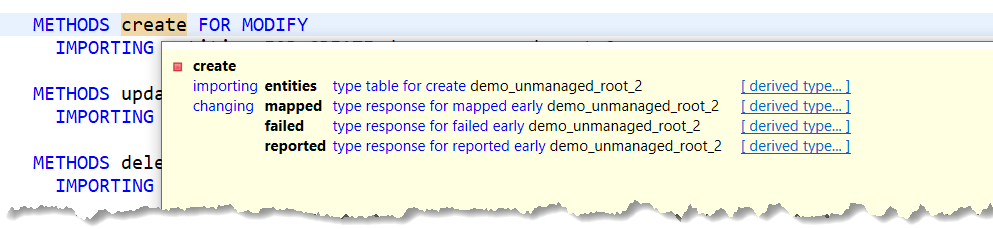
- The response parameters
mapped,failedandreported(the names are predefined) can be considered as containers for information - information a RAP BO consumer is provided with by a RAP BO provider, for example, an SAP Fiori app displays an error message if something went wrong. The availability of the parameters depends on the handler method used (e. g.mappedis only available for operations creating instances).mapped: Used to provide mapping information on RAP BO instances, for example, which key values were created for given content IDs (%cid).failed: Information for identifying the data set for which an error occurred in a RAP operationreported: Used to exchange error messages for each entity defined in the BDEF and not related to a specific entity.- Example: Technically, the
reportedparameter is a deep structure containing, for example, the messages of the root entity and child entities. For example, if a create operation fails for a RAP BO instance of the root entity, a message, information about the instance key and other things can be included in this parameter which is passed to a RAP BO consumer. You could imagine that such an error message is displayed on an SAP Fiori UI if something goes wrong to inform the user.

RAP Saver Class and Saver Methods
- A RAP saver class implements the RAP save sequence. A saver class is usually only available in unmanaged RAP BOs (except for special variants of managed RAP BOs that are not outlined here).
- The saver class is implicitly
ABSTRACTandFINALsince the instantiating and calling only happens through the RAP runtime engine. - A saver class can be defined in the CCIMP include of an ABAP behavior pool. It includes the definitions and implementations of RAP saver methods.
- The saver methods consist of a set of predefined methods having
predefined names. Some of them are mandatory to implement, some are
optional. The
adjust_numbersmethod is only available in late numbering scenarios. - A saver class inherits from class
CL_ABAP_BEHAVIOR_SAVER. The saver methods are declared by redefining predefined methods of the superclass. They implicitly have response parameters. - In contrast to RAP handler methods, saver methods do not have data of RAP BO instances as import parameter. Therefore, instance data must be handled via the transactional buffer when self-implementing the saver methods.
- All saver methods are called after at least one successful
modification of data in the current RAP LUW, for example, by
triggering the save sequence using a
COMMIT ENTITIESstatement. - Find more information on RAP saver methods here.
Example: Definition of a RAP saver class and saver methods
CLASS lsc_bdef DEFINITION INHERITING FROM cl_abap_behavior_saver.
  PROTECTED SECTION.

    "For final calculations and data modifications involving all
    "BOs in the current RAP LUW
    METHODS finalize REDEFINITION.

    "Checks the consistency of the transactional buffer before
    "the save method saves data to the database
    METHODS check_before_save REDEFINITION.

    "Preliminary IDs are mapped to final keys. Only for late numbering.
    METHODS adjust_numbers REDEFINITION.

    "Saves the current state of the transactional buffer to the database
    METHODS save REDEFINITION.

    "Clear the transactional buffer
    METHODS cleanup REDEFINITION.
    METHODS cleanup_finalize REDEFINITION.

ENDCLASS.
BDEF Derived Types
The operands of EML statements and parameters of handler and saver methods are mainly special messenger tables for passing data and receiving results or messages, i. e. the communication between a RAP BO consumer and the RAP BO provider using EML consists (in most cases) of exchanging data stored in internal tables that have special ABAP types - BDEF derived types. These types are tailor-made for RAP purposes.
As the name implies, the types are derived by the ABAP runtime framework from CDS entities and their behavior definition in the BDEF. With these special types, a type-safe access to RAP BOs is guaranteed.
You can create internal tables (using TYPE TABLE FOR),
structures (using TYPE STRUCTURE FOR)
and data types with BDEF derived types. For all operations and behavior
characteristics defined in the BDEF, types can be derived.
The syntax uses - similar to the method definitions mentioned before -
the addition FOR followed by the operation and the name of an
entity (and, if need be, the concrete name, e. g. in case of an action
defined in the BDEF).
Each BDEF derived type can be categorized as
input
or output derived
type
according to its use as importing or exporting parameters in methods of
RAP BO providers. In most cases, structures of type TYPE STRUCTURE FOR can be considered as serving as work
area
and line type of the internal tables. However, there are also structured
derived types that do serve as types for handler method parameters.
The response parameters mapped, failed and
reported have dedicated derived types: TYPE RESPONSE FOR.
They are deep structures containing the information for the individual
entities of the RAP BO. The components of these structures are internal
tables of appropriate types with TYPE TABLE FOR.
Examples for BDEF derived types:
"Data objects with input derived types (entity = name of a root entity)

"For an EML create operation

DATA create_tab TYPE TABLE FOR CREATE entity.

"For an update operation

DATA update_tab TYPE TABLE FOR UPDATE entity.

"Type for create-by-association operations specifying the name of the entity
"and the association

DATA cba_tab TYPE TABLE FOR CREATE entity\_child.

"For an action execution; the name of the action is preceded by a tilde

DATA action_imp TYPE TABLE FOR ACTION IMPORT entity~action1.

"Data objects with output derived types

"For a read operation

DATA read_tab TYPE TABLE FOR READ RESULT entity.

"For an action defined with a result

DATA action_res TYPE TABLE FOR ACTION RESULT entity~action2.

"Examples for structures and types

DATA create_wa TYPE STRUCTURE FOR CREATE entity.

"For permission retrieval

DATA perm_req TYPE STRUCTURE FOR PERMISSIONS REQUEST entity.

"For retrieving global features

DATA feat_req TYPE STRUCTURE FOR GLOBAL FEATURES RESULT entity.

"Type declaration using a BDEF derived type

TYPES der_typ TYPE TABLE FOR DELETE entity.

"Response parameters

DATA map TYPE RESPONSE FOR MAPPED entity.
DATA fail TYPE RESPONSE FOR FAILED entity.
DATA rep TYPE RESPONSE FOR REPORTED entity.
💡 Note
Some of the derived types can only be created and accessed in implementation classes.
Components of BDEF Derived Types
Many of the BDEF derived types contain components of CDS entities like
key and data fields that retain their original line type, for example, a
messenger table typed with TYPE TABLE FOR CREATE. Certainly,
if an instance is to be created, key and field values of a RAP BO
instance are of relevance.
Yet, all BDEF derived types contain special RAP components serving a
dedicated purpose. The names of these RAP components begin with
% to avoid naming conflicts with components of the CDS
entities. The following image shows the F2 information of a BDEF derived
type containing the % components and fields from the CDS
entity.

Some of the % components are component
groups
summarizing groups of table columns under a single name. In doing so,
they simplify the handling of derived types for developers. For example,
the component group
%data
contains all primary key and data fields of a RAP BO entity (actually,
by containing the keys, it also contains the component group
%key
in the case above). The F2 information in ADT helps you find out about
the available components in a variable. The image below shows the
details of %data when clicking the derived type
link in the first ADT F2 information screen.

The availability of % components depends on definitions in the
BDEF. Their availability also depends on more criteria, for example, the
scenario. For example, the component
%pid
that represents a preliminary ID for a RAP BO instance is only available
in late
numbering
scenarios. The draft indicator
%is_draft
is only available in the context of
draft.
Find more details on the available components in section Components of BDEF Derived Types.
Bullet points on selected % components:
%cid- A string to define a content ID.
- Content IDs are used as a unique and preliminary identifier for RAP BO operations in which instances are created and especially in cases where the key values of RAP BO instances are not yet determined
- Assume that you create a RAP BO instance with an EML create
request and the key value has not yet been determined. In the
same request - a save has not yet been triggered - an update is
requested for this RAP BO instance. Using the content ID, it is
guaranteed that the update operation happens for the desired
instance. For this purpose, derived types for operations like
update or delete include the component
%cid_refto refer to the content ID%cidas the name implies. - Note: You should always fill
%cideven if not needed. The specified content ID is only valid within one ABAP EML request.
%key/%tky- Both are component groups summarizing all primary keys of a RAP BO instance.
- Where possible, it is recommended that you use
%tkyinstead of%key.%tkyincludes%keyand also the draft indicator%is_draft. When using%tkyin non-draft scenarios, you are prepared for a later, potential switch to a draft scenario. In doing so, you can avoid lots of adaptations in your code by manually adding the indicator.
%control- Component group that, for example, contains the names of all key and data fields of a RAP BO instance which indicate flags.
- Used to get information on which fields are provided or set a flag for which fields are requested by RAP BO providers or RAP BO consumers respectively during the current transaction.
- For this purpose, the value of each field in the
%controlstructure is of typeABP_BEHV_FLAG. For the value setting, you can use the structured constantmkof interfaceIF_ABAP_BEHV. Note that the technical type isx length 1. - Example: If you want to read data from a RAP BO instance and
particular non-key fields in
%controlare set toif_abap_behv=>mk-off, the values of these fields are not returned in the result.
EML Syntax
The focus is here on selected EML statements. These statements can be fairly long and various additions are possible. Find more information on the EML statements here.
EML Syntax for Modifying Operations
The modifying operations covered include the standard operations (using
the additions
CREATE,
CREATE BY,
UPDATE,
and
DELETE
and non-standard operations (actions) using the addition
EXECUTE.
All EML statements for the mentioned operations begin with
MODIFY.
The following commented code snippets demonstrate the
short
and long
form
of EML MODIFY statements.
Create operation for creating new instances of a RAP BO entity:
"Declaration of data objects using BDEF derived types

DATA: cr_tab        TYPE TABLE FOR CREATE root_ent,    "input derived type
      mapped_resp   TYPE RESPONSE FOR MAPPED root_ent, "response parameters
      failed_resp   TYPE RESPONSE FOR FAILED root_ent,
      reported_resp TYPE RESPONSE FOR REPORTED root_ent.

"Input derived type for the EML statement is filled using the VALUE operator
"Assumption: key_field is the key field having type i,
"field1 and field2 are data fields with character-like data type.
"Specify %cid even if not used or of interest; it must be unique within a RAP LUW

cr_tab = VALUE #(
        ( %cid   = 'cid1' key_field = 1
          field1 = 'A'    field2    = 'B' )
        ( %cid = 'cid2'
          "Just to demo %data/%key. You can specify fields with or without
          "the derived type components
          %data = VALUE #( %key-key_field = 2
                          field1         = 'C'
                          field2         = 'D' ) ) ).

"EML statement, short form
"root_ent must be the full name of the root entity, it is basically the name of the BDEF

MODIFY ENTITY root_ent
  CREATE "determines the kind of operation
  FIELDS ( key_field field1 field2 ) WITH cr_tab   "Fields to be respected for the
                                                   "input derived type and the input
                                                   "derived type itself
  MAPPED mapped_resp          "mapping information
  FAILED failed_resp          "information on failures with instances
  REPORTED reported_resp.     "messages
💡 Note
- Addition
FIELDS ( ... ) WITH: This field selection option specifies which fields are to be respected for the operation. The derived type, i. e. an internal table containing the concrete RAP BO instance values, followsWITH. If a field is specified in the field list within the pair of parentheses afterFIELDS, the%controlflag for this field is automatically set toif_abap_behv=>mk-on. Likewise, if a field is not contained in the list, the flag in%controlis set toif_abap_behv=>mk-off. Assumefield2is not specified in the list. The value forfield2will not be respected (even if a value is specified in the internal table). The initial value will be used for the field.- Retrieving the responses and specifying the parameters is optional. Assuming a data set with the value 2 for
key_fieldalready exists on the database for this BO, you should expect an entry for this particular instance in thefailed_respoperand and potentially an error message inreported_resp, too. Nevertheless, especially in ABP implementations and depending on the context, you should implement and fill these parameters according to the RAP BO contract to meet the variety of implementation rules.%cidshould be provided even if you are not interested in it and subsequent operations do not require the reference.
Long form of an EML MODIFY statement:
MODIFY ENTITIES OF root_ent      "full name of root entity
  ENTITY root                    "root or child entity (alias name if available)
  CREATE FROM                    "FROM as further field selection variant
  VALUE #( ( %cid      = 'cid'   "Input derived type created inline
             key_field = 3
             field1    = 'E'
             field2    = 'F'
             %control = VALUE #(                "Must be filled when using FROM
               key_field = if_abap_behv=>mk-on
               field1    = if_abap_behv=>mk-on
               field2    = if_abap_behv=>mk-on ) ) )
  MAPPED DATA(m)       "Target variables declared inline
  FAILED DATA(f)
  REPORTED DATA(r).
💡 Note
- The entity specified after
ENTITYcan be either the root entity itself or a child entity. If an alias is defined, the alias should be used.- The addition
FIELDS ( ... ) WITHfrom the previous snippet is basically a shortcut for the additionFROMthat is used here. When usingFROM, the values of the%controlstructure must be specified explicitly.- The BDEF derived types can also be created inline as shown in the example using a constructor expression for the input derived type and with
DATAorFINALfor the responses.- The long form allows you to bundle several operations in one statement, either different operations on the same entity (for example, deleting some instances and updating some others) or operations on different entities of the same RAP BO (for example, creating a root entity instance and related instances of a child entity in one EML request). Long and short forms are also available for other EML statements.
The following EML statement combines multiple operations in one EML
request. It demonstrates the use of %cid and
%cid_ref. First, two instances are created by specifying
%cid. An update operation in the same request only specifies a
certain field within the parentheses of the FIELDS ( ... ) WITH addition which denotes that only this particular field
should be updated. The other field values remain unchanged. The
reference to the instance is made via %cid_ref. Consider an
EML request in which no instance to refer to using %cid_ref
exists, e. g. for an update operation. You can also make the reference
using the unique key. A delete operation is available in the same
request, too. DELETE can only be followed by the addition
FROM. In contrast to other derived types, the derived type
that is expected here (TYPE TABLE FOR DELETE) only has
%cid_ref and the key as components.
MODIFY ENTITIES OF root_ent
  ENTITY root
  CREATE FIELDS ( key_field field1 field2 ) WITH
    VALUE #( ( %cid    = 'cid4' key_field = 4
                field1 = 'G'    field2    = 'H' )
              ( %cid   = 'cid5' key_field = 5
                field1 = 'I'    field2    = 'J' ) )

  UPDATE FIELDS ( field2 ) WITH
    VALUE #( ( %cid_ref = 'cid4' field2 = 'Z' ) )

  DELETE FROM
    VALUE #( ( %cid_ref  = 'cid5' ) "Instance referenced via %cid_ref
             ( key_field = 9 ) )    "Instance referenced via the key
...
EML statement including the execution of an action:
MODIFY ENTITIES OF root_ent
  ENTITY root
  EXECUTE some_action
      FROM action_tab
    RESULT DATA(action_result) "Assumption: The action is defined with a
                               "result parameter.
    ...
The following code snippet shows a deep create. First, an instance is
created for the root entity. Then, in the same request, instances are
created for the child entity based on the root instance. In the example
below, the assumption is that a composition is specified in the root
view entity like composition [1..*] of root_ent as _child and key_field and
key_field_child are the keys of the child view entity. The
%target
component group enters the picture here which contains the target's
primary key and data fields.
MODIFY ENTITIES OF root_ent
  ENTITY root_ent
  CREATE FIELDS ( key_field field1 field2 ) WITH
    VALUE #( ( %cid = 'cid6' key_field = 6
                field1 = 'I' field2 = 'J' ) )
  CREATE BY \_child
  FIELDS ( key_field_child field1_child field2_child  ) WITH
    VALUE #( ( %cid_ref = 'cid6'
                %target = VALUE #( ( %cid            = 'cid_child_1'
                                     key_field_child = 1
                                     field1_child    = 'aa'
                                     field2_child    = 'bb' )
                                   ( %cid            = 'cid_child_2'
                                     key_field_child = 2
                                     field1_child    = 'cc'
                                     field2_child    = 'dd' ) ) ) )
...
EML Syntax for Reading Operations
- Read-only operations always return a result, i.e. the syntax of the
EML statement requires the addition
RESULTand an operand. - When RAP BO instances are read, the returned data include the current status of instances in the transactional buffer which includes unsaved modifications on instances. If an instance is not yet available in the transactional buffer, the currently persisted data set is automatically read into the transactional buffer.
- Note that read operations are always implicitly enabled for each entity listed in a BDEF, i. e. there is no extra definition in the BDEF in contrast to, for example, create or update.
The following code snippet shows the long form of the EML
READ
statement for reading instances from the root entity. In READ
statements, the additions FIELDS ( ... ) WITH and
FROM can also be used to specify the fields that you intend to
read. Here, the addition ALL FIELDS WITH
is available for reading all field values.
READ ENTITIES OF root_ent
  ENTITY root_ent
  ALL FIELDS WITH
  VALUE #( ( key_field = 1 )   "Derived type TYPE TABLE FOR READ IMPORT
                               "only includes the keys
           ( key_field = 2 ) )
  RESULT DATA(result)
  FAILED DATA(f)
  REPORTED DATA(r).
Read-by-association operations include the optional addition
LINK
with which you can retrieve the keys of the source and target (i. e. the
associated entity). The by-association operations work reciprocally, i.
e. you can, for example, read a child instance via the parent and a
parent instance via the child, too.
"Read-by association operation: parent to child
READ ENTITIES OF root_ent
  ENTITY root_ent
  BY \_child
  ALL FIELDS WITH VALUE #( ( key_field = 1 ) )
  RESULT DATA(rba_res1)
  LINK DATA(links1).
  ...

"Read-by association operation: child to parent
READ ENTITIES OF root_ent
  ENTITY child_ent
  BY \_parent
  ALL FIELDS WITH VALUE #( ( key_field = 1 key_field_child = 1 ) )
  RESULT DATA(rba_res2)
  LINK DATA(links2).
  ...
Persisting to the Database
- A
COMMIT ENTITIESstatement triggers the RAP save sequence. Without such a statement, the modified RAP BO instances that are available in the transactional buffer are not persisted to the database. COMMIT ENTITIESimplicitly includesCOMMIT WORK.- Note:
COMMIT ENTITIESstatements cannot be used in behavior implementations. In case of a natively supported RAP scenario (for example, when using OData), theCOMMIT ENTITIESrequest is executed automatically. - There a multiple variants available for the statement as described in the ABAP Keyword Documentation here.
COMMIT ENTITIESstatements set the system fieldsy-subrc. When usingCOMMIT ENTITIES, it is not guaranteed thatCOMMIT WORKis carried out successfully. Hence, you should include a check forsy-subrcafterCOMMIT ENTITIESso that you can react to failures accordingly.
The following snippet shows a create operation. This operation has only
an impact on the database with the COMMIT ENTITIES statement.
Triggering the save sequence means that the execution of the statement
triggers the calling of the saver methods available in the saver class
of a behavior implementation. In managed scenarios (except for some
special variants), the saving is done automatically without implementing
a dedicated saver method.
MODIFY ENTITIES OF root_ent
  ENTITY root_ent
  CREATE FIELDS ( key_field field1 field2 ) WITH
  VALUE #( ( %cid = 'cid' key_field = 7
             field1 = 'K' field2 = 'L' ) ).

COMMIT ENTITIES.

IF sy-subrc <> 0.
  ...
ENDIF.
EML Statements in ABAP Behavior Pools
- There are a special additions when using EML in behavior
pools.
One of them is
IN LOCAL MODE. - This addition can be used to exclude feature controls and authorization checks.
- Consider the following use case: There is a field to display the
booking status of a trip on a UI. In the BDEF, this field is
specified as read-only. Hence, it cannot be modified by a user on
the UI. However, there is a button on the UI to book the trip. This
button might trigger an action to book the trip so that the value of
the field changes from open to booked. To enable this, the
underlying handler method for the modify operation with the action
to be executed has the addition
IN LOCAL MODEthat ignores the feature control.
Syntax:
MODIFY ENTITIES OF root_ent IN LOCAL MODE
  ENTITY root
  EXECUTE book
  FROM action_tab
  ...
Excursion: Using Keys and Identifying RAP BO Instances in a Nutshell / RAP Concepts
Using Keys and Identifying RAP BO Instances in a Nutshell
The following bullet points outline important aspects regarding keys and identifying RAP BO instances in ABAP EML statements.
Why is it important?
- The primary key of a RAP BO entity instance is composed of one or more key fields.
- These key fields stand for the fields that are specified with
keyin the underlying CDS view entity of the RAP BO. - The primary key uniquely identifies each RAP BO entity instance.
- After the creation of an instance and the primary key during a RAP create operation,
the primary key cannot be changed.
- Note the concept of late numbering where newly created entity instances are given their final key only shortly before saving in the database. Until then, the business logic uses a temporary key that has to be replaced.
- If a data set with a particular primary key already exists in the persistent database table, the saving of a RAP BO instance with a duplicate primary key is rejected.
How can a RAP BO instance be uniquely identified?
- It can be done by using a RAP instance identifier or RAP content identifier or both of them.
- RAP instance identifier:
- It consists of the primary key fields and all relevant BDEF derived type components.
- To ease the reference to all of these components, special component groups are available to summarize the components and make them addressable via one single name.
%key: Contains the primary key fields of a RAP BO instance%tky: Specifies the transactional key. Comprises%key(and, thus, the primary key fields of a RAP BO instance) and more components that are relevant to uniquely identify a RAP BO instance. Among them,%pid(relevant for late numbering scenarios) and the draft indicator%is_draft(relevant for draft scenarios). In non-late numbering or non-draft scenarios, these extra components are just blank. However, it is recommended that you use%tkyin all scenarios since it simplifies a possible later switch, for example, to a draft scenario. In doing so, lots of adaptations to the code regarding the keys and the inclusion of%is_draftcan be avoided.
- RAP content identifier:
- Reflected in the component
%cidwhich is a string of typeABP_BEHV_CIDto define a content ID. - Used as a unique and preliminary identifier for RAP BO instances in RAP create operations, especially where no primary key exists for the particular instance.
- For newly created instances, the ID can then be used for
performing further, referencing modifications on those instances
using
%cid_ref(which has the same value as%cidis then used, for example, in RAP operations usingCREATE BY,UPDATEandDELETE, as well as actions withEXECUTE). - In contrast to the primary key and the preliminary ID
%pidfor late numbering scenarios,%cid(and%cid_ref) are only available on a short-term basis for the current ABAP EML request within the RAP interaction phase in one RAP LUW. - Note: The specification of
%cidshould be done even if there are no further operations referring to it.
- Reflected in the component
- Special case: Late numbering
- As mentioned above, in late numbering scenarios newly created entity instances are given their final key only shortly before saving in the database, i. e. you deal with preliminary keys in the RAP interaction phase and the early phase of the RAP save sequence.
- In this case, you can use
%keyto hold the preliminary keys or use a preliminary ID in the dedicated component%keywhich is of typeABP_BEHV_PIDand only available in late numbering scenarios. - Similar to above, to uniquely identify RAP BO instances in late
numbering scenarios, you can use either
%keyor%pidor both of them. In any case, the use of%tkyis handy because it includes both components. You must ensure that%tkyin total uniquely identifies the instances. - Note: A further component group to refer to the keys is available:
%pky.%pkycontains%pidand%keyin late numbering scenarios. In non-late numbering scenarios, it just contains%key.%pkyitself is contained in%tky. There are contexts, for example, particular actions, where%tkyis not available but%pkyis. This way, there is still the option to summarize%pidand%keyin one component group in the absence of%tky.
General rule: A RAP BO instance must always be uniquely
identifiable by its transactional key (%tky) for internal
processing during the RAP interaction phase. %tky always
contains all relevant components for the chosen scenario.
RAP Concepts
RAP numbering
- A concept that deals with setting values for primary key fields.
- There are multiple options to handle the numbering for primary key fields depending on when (early in the RAP interaction phase or late in the RAP save sequence) and by whom (RAP BO consumer, behavior pool, or framework) the primary key values are set.
- When:
- Early numbering: The final key values are assigned during a RAP create operation in the interaction phase.
- Late numbering:
The final key values are assigned during the RAP save sequence
(and here only in the RAP saver method
adjust_numbers).
- By whom
- External numbering: Key values are provided by the RAP BO consumer. For example, in a create operation, the key values are specified by the RAP BO consumer like other non-key field values. Basically, this is the concept with which the snippets above are tailored.
- Internal numbering: Key values are provided by the RAP BO provider. For example, in a create operation, the key values are not specified in an EML create request by the RAP BO consumer but rather by the RAP BO provider. In case of a managed RAP BO, the key is automatically created by the framework which only works if the key is of a certain type (16-character byte-like UUID). In case of an unmanaged RAP BO, the key values are provided in a dedicated handler method which must be self-implemented. Note that late numbering is internal by default since no further RAP BO consumer interaction is possible in the late phase of the RAP save sequence.
Draft
- The draft concept in RAP allows the content of the transactional buffer to be stored in intermediate storages (draft tables) in order to allow transactions to expand over different ABAP sessions.
- Like the concepts mentioned above, a RAP BO can be draft-enabled in the BDEF. This concept enters the picture, for example, if you have an application allowing data modifications and the temporary storage of modifications but does not yet persist them to the database. You can continue modifying this data later and you might even use a different device from the one where you modified the data previously.
- The draft indicator
%is_draftenters the picture here for RAP BO instance identification. It is used to indicate if a RAP BO instance is a draft instance or an active instance. Conveniently, the component group%tkycontains%is_draft.%is_draftcan then be addressed via%tky.
💡 Note
Late numbering and identification in the late phase of the RAP save sequence
- Context: RAP saver method
adjust_numbersin which the final key values are assigned; the preliminary keys can be included in%keyor%pidor both of them.%pidand the preliminary key values in%keyare automatically assigned to the following component groups when reaching theadjust_numbersmethod:%tmp: A component group that is assigned the preliminary key values contained in%key. In doing so,%tmptakes over the role that%keyhas had in the RAP interaction phase to hold the preliminary key values.%pidremains as is. The component group%precontains%pidand%tmpand, thus, all preliminary identifiers.- In the
adjust_numbersmethod, the preliminary keys are transformed into the final keys, i. e. the preliminary keys are mapped to%key(which holds the final keys in this context) in themappedresponse parameter.- Depending on your use case to use either
%pidor (the preliminary key values in)%key(which is%tmphere in this method) during the interaction phase or both of them, you must ensure that%prein total (since it contains both%pidand%tmp) is unique and mapped to the final keys that are to be contained in%key.
Further Information
- Section ABAP for RAP Business Objects in the ABAP Keyword Documentation including EML
- Development guide for the ABAP RESTful Application Programming Model
- RAP Contract: Rules for the RAP BO provider and consumer implementation to ensure consistency and reliability
Executable Examples
This cheat sheet is supported by different executable examples demonstrating various scenarios:
- Demo RAP scenario with a managed RAP BO, external numbering: zcl_demo_abap_rap_ext_num_m
- Demo RAP scenario with an unmanaged RAP BO, external numbering: zcl_demo_abap_rap_ext_num_u
- Demo RAP scenario ("RAP calculator") with a managed, draft-enabled RAP BO, late numbering zcl_demo_abap_rap_draft_ln_m
💡 Note
- To reduce the complexity, the executable examples are purposely kept simple and only focus on the technical side. ABAP classes play the role of a RAP BO consumer here.
- The examples do not represent real life scenarios and are not suitable as role models for proper RAP scenarios. They rather focus on the technical side by giving an idea how the communication and data exchange between a RAP BO consumer and RAP BO provider can work. Additionally, the examples show how the methods for non-standard RAP BO operations might be self-implemented in an ABAP behavior pool.
- Due to the simplification, the examples might not fully meet the requirements of the RAP BO contract in many respects.
- The "RAP calculator" example can be checked out using the preview version of an SAP Fiori Elements UI. See the comments in the class for more information.
- See the steps outlined here about how to import and run the code.